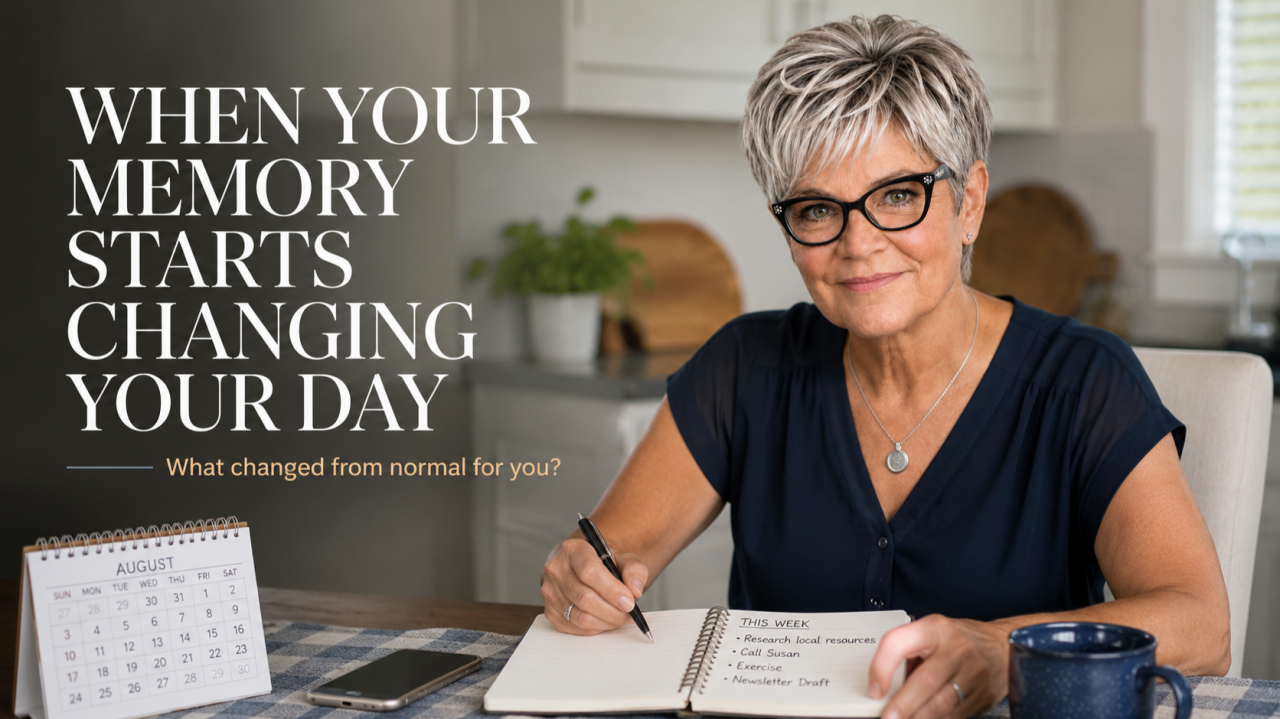
Sometimes the better question is not What is wrong with me? It is What changed from normal for me?
Not every memory slip starts with memory. Sometimes it starts with stress, overload, poor sleep, or divided attention. A better question than “I’m getting older.”
You walk into a room and forget why you went in there.
You reread the same paragraph because none of it stuck.
Someone tells you something while you’re checking your phone, and five minutes later you’re asking them to tell you again.
You reach for a word you know perfectly well, and it just won’t come.
At 60, I’m not going to turn every one of those moments into something scary.
But I’m also not interested in brushing off every change with, “Well, I’m getting older.”
I think there’s a better place to start.
What changed from normal for you?
First, not every memory slip means something is wrong
Some changes in memory really can happen with normal aging.
The National Institute on Aging says people may take longer to remember information or learn something new. Occasionally misplacing something, forgetting a word and remembering it later, or forgetting something once in a while can happen as we get older.
That matters, because I don’t think women need another reason to panic every time we forget where we put the glasses that are sitting on top of our head.
But there’s another side to this conversation.
Sometimes what feels like a memory problem starts with attention
Think about a normal day.
You’re looking at your phone while somebody is talking.
You’re thinking about dinner while answering an email.
The calendar is open, somebody needs something, you’re trying to remember an appointment, and you’ve already mentally moved three steps ahead.
Then later you think:
Why can’t I remember anything anymore?
Before deciding your memory is failing, it’s worth asking how much information was actually getting your full attention in the first place.
Sleep belongs in that conversation too. The National Institute on Aging notes that sleep supports attention, learning, problem-solving, and the formation of new memories. Poor-quality sleep can contribute to memory problems.
That doesn’t explain every memory change.
It just gives us a better question than immediately blaming age.
Not every memory slip starts with memory. Sometimes it starts with stress, overload, poor sleep, or divided attention.
There are other things worth looking at too
Memory changes aren’t caused only by aging or dementia.
The National Institute on Aging lists a number of other possible contributors, including medication side effects, sleep problems, depression or anxiety, thyroid problems, vitamin B12 deficiency, alcohol or drug misuse, and major stressful life events.
Look at that list for a minute.
Those are very different things.
Which is exactly why “I’m getting older” isn’t much of an investigation.
It describes your age.
It doesn’t tell you what changed.
So what deserves more attention?
This is where I would look less at the occasional mistake and more at the pattern.
Are you forgetting something once in a while, or is this happening noticeably more often than it used to?
Can you retrace your steps and find the thing you misplaced, or are you regularly unable to figure out where things went?
Did you forget the date and remember later, or are you frequently becoming confused about time or place?
Is it annoying, or is it starting to interfere with things you normally handle?
The National Institute on Aging specifically recommends talking with a healthcare professional when memory or thinking changes concern you, particularly when they begin interfering with everyday tasks. Examples include repeatedly asking the same questions, getting lost in familiar places, having trouble following directions, or becoming confused about people, time, or place.
And that distinction matters.
Dementia is not considered a normal part of aging.
Before you assume it is just aging, write down what changed, when it started, and how it is showing up in your day.
Here’s what I would write down before the appointment
Not a diagnosis.
Not a theory you found online.
Just observations.
What changed?
When did you first notice it?
What does it actually look like in your day?
Is it happening more often?
Has your sleep changed?
Did a medication change?
Has your stress been unusually high?
And most importantly:
Is this different from normal for you?
Those details give you something much more useful to discuss than walking into an appointment and saying, “My memory seems bad lately.”
Paying attention without panicking is a better place to start.
That’s the part I want women to get comfortable doing
Paying attention without panicking.
Asking questions without diagnosing ourselves.
And refusing to let age become the automatic explanation for every change we notice.
I’m 60.
I expect some things about my body and brain to be different than they were at 30.
What I don’t want to do is stop being curious about those differences.
If something changes, I want to notice the pattern.
I want to ask what else changed around it.
And if it keeps happening or starts changing the way I function, I want to bring that information to someone qualified to help me understand why.
Sometimes the answer may be ordinary.
Sometimes it may be something worth addressing.
But “you’re getting older” shouldn’t be where the questions stop.
Four human supplementation studies, a much larger mechanistic literature, and where the evidence stops. A closer look at what 30 PubMed records actually represent.
Raising grandchildren can bring questions you never expected. Start with a place for your notes, the next person to ask, and a working companion you can return to.