
Healthy Aging From the Inside
When Memory Starts Changing Your Day
Not every memory slip starts with memory. Sometimes it starts with stress, overload, poor sleep, or divided attention. A better question than “I’m getting older.”
Read the article
Healthy Aging From the Inside

Thirty PubMed records sounds like a lot. The more useful question is what kind of research those 30 records actually represent.
Four human supplementation studies, a much larger mechanistic literature, and where the evidence stops. A closer look at what 30 PubMed records actually represent.
Four human supplementation studies, a much larger mechanistic literature, and where the evidence stops
A PubMed search run on October 22, 2026 returned 30 records for Protandim.
The number sounds impressive on its own. Once the records are sorted by what researchers actually did, the picture becomes much clearer.
Four records are human studies where people took Protandim. Seventeen are original studies involving animals, cultured cells or human tissue studied outside the body. Seven are reviews or commentary pieces. One reanalyzed existing research data, and one is a published correction to the 2016 runner trial.
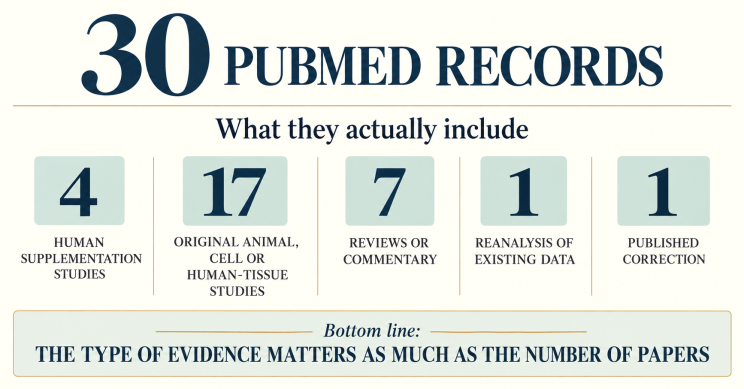
That breakdown is important because the Protandim research is much larger on mechanism than it is on human outcomes.
So I want to separate those two questions.
What has Protandim been shown to do in people?
And what has been shown about Nrf2 in cells, tissue, and other research models?
The first human study was published in 2006.
Twenty-nine healthy adults between 20 and 78 years old took 675 mg of Protandim each day. Researchers measured TBARS, a blood measurement used to estimate oxidative damage involving fats, along with the antioxidant enzymes superoxide dismutase, usually shortened to SOD, and catalase.
After 30 days, average TBARS had fallen 40%. By 120 days, SOD activity had increased 30%, and catalase had increased 54%.
Those are the reported numbers.
The study did not use a randomized, double-blind, placebo-controlled design. The participants were measured before taking Protandim and again afterward. That makes it useful evidence, but it does not give us the same protection against coincidence, outside changes, and placebo effects that a randomized controlled trial would.
Two authors, Paul Myhill and Joe McCord, also listed Lifeline Therapeutics as an affiliation on the paper.
The next human trial, published in 2012, looked very different.
Thirty people with alcohol use disorders who had recently stopped drinking were randomly assigned to receive either 1,350 mg of Protandim a day or placebo for seven days.
Researchers were studying lung permeability and several measurements related to oxidative stress and inflammation in the lungs.
Protandim did not significantly change the main lung-permeability outcome or the pulmonary oxidative-stress measurements researchers tested.
This trial was supported by National Institutes of Health grants. LifeVantage provided the study medication. The paper also disclosed that Joe McCord was a LifeVantage employee and had a financial interest in the company greater than $10,000.
Then came the 2016 runner trial.
Thirty-eight runners were randomly assigned to Protandim or placebo for about three months. This study is especially useful because researchers measured laboratory markers and something very easy to understand: 5K running performance.
Protandim did not significantly improve 5K time compared with placebo.
It also did not significantly improve resting TBARS, SOD, or glutathione peroxidase across the full group, and quality of life was not different between the two groups.
There was an additional result among runners age 35 and older. SOD increased more in that subgroup with Protandim than with placebo.
That result needs more context than it usually gets.
The age analysis was not part of the original study plan. The published paper says an independent statistician hired by LifeVantage performed the subgroup analysis. LifeVantage suggested including that result in the manuscript, and the researchers did.
A 2020 correction later emphasized that the study did not have enough participants to fully assess age effects.
LifeVantage funded the principal investigator and also paid for graduate-student support, equipment, supplies, independent blood testing, conference expenses, and publication fees.
The main randomized result and the later age subgroup result are both part of the paper. They are not equally strong evidence.
The fourth human study was published in 2017.
Forty-six older adults completed a six-week randomized, double-blind, placebo-controlled study involving milk protein. Fifteen were in the Protandim group.
Nrf2 is a protein that helps regulate genes involved in how cells respond to oxidative stress.
Researchers found an increase in HO-1 protein in the Protandim group. HO-1 is one protein associated with the Nrf2 response.
They did not find an increase in the Nrf2-related gene-expression measurements they tested, including HO-1 mRNA, GPx1, and NQO1. They also did not find a significant reduction in systemic oxidative stress or skeletal-muscle oxidative damage with Protandim.
There were changes in protein synthesis too. Myofibrillar protein synthesis was maintained, while mitochondrial and cytoplasmic protein synthesis rates were lower than the control group.
The authors concluded that Protandim may affect mechanisms involved in maintaining skeletal-muscle proteins.
I would leave that conclusion where they left it.
The study was supported by the Dairy Research Institute and LifeVantage.
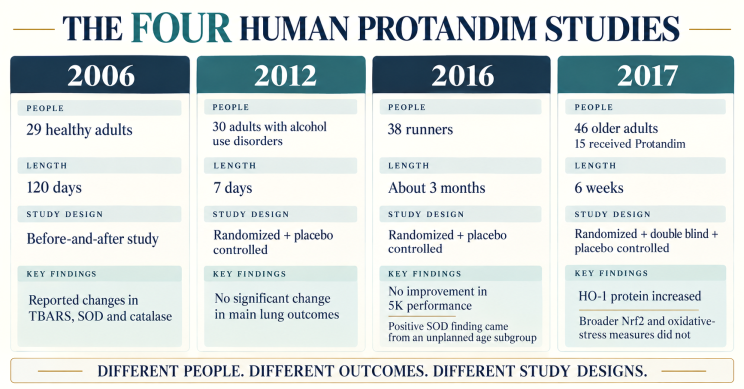
This is where the picture becomes easier to see.
The 2006 study had 29 healthy adults and reported sizeable changes in several blood biomarkers, but it was not a randomized placebo-controlled trial.
The 2012 study was randomized and placebo-controlled, involved 30 people with alcohol use disorders, lasted seven days, and did not find significant changes in its main lung outcomes.
The 2016 study was randomized and placebo-controlled, included 38 runners, and lasted about three months. It found no improvement in 5K performance or several overall oxidative-stress and antioxidant measurements. The positive SOD result came from an unplanned age subgroup.
The 2017 study was randomized, double-blind, and placebo-controlled. It included 46 older adults across three groups, with 15 receiving Protandim. It found an increase in one Nrf2-related protein but did not show broader changes across the other Nrf2 gene measurements, oxidative stress, or muscle oxidative damage that researchers tested.
These are four very different studies in four very different groups of people.
That is why I would be careful with broad statements about what the human research proves.
The Protandim literature also includes studies designed to look much more directly at the Nrf2 pathway.
One used cultured human coronary artery endothelial cells, the cells that line the inside of blood vessels.
Researchers treated those cells with Protandim and saw Nrf2 move into the nucleus, where it can affect gene activity. Several antioxidant proteins increased as well.
When researchers reduced Nrf2 activity, part of Protandim's protective effect against an oxidative challenge was reduced.
That is direct evidence of Nrf2-related activity in cultured human cells.
Another study used human saphenous vein tissue kept alive outside the body. Protandim increased SOD activity about threefold, HO-1 about sevenfold, and catalase about twelvefold. It also reduced superoxide and 4-HNE, two measurements associated with oxidative stress.
Those are useful mechanistic findings.
They were measured in cells and tissue outside a living person.
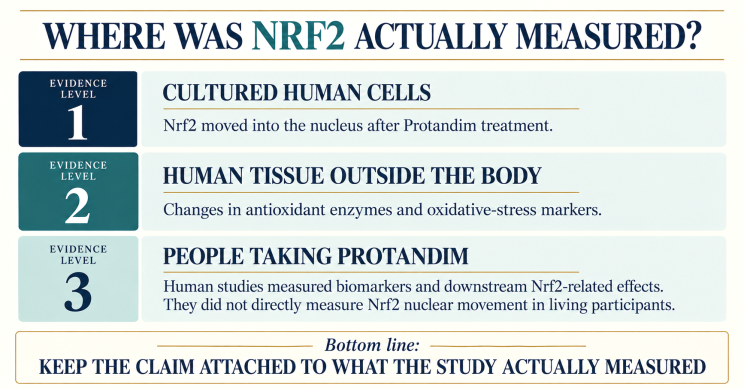
That distinction becomes important when the claim changes from Protandim has Nrf2-related laboratory evidence to Protandim has been directly shown to activate Nrf2 in people who take it.
Among the four human supplementation studies in this PubMed set, none directly measured Nrf2 moving into the nucleus of cells in living participants after they took Protandim.
The 2017 study came closest to examining downstream Nrf2-related biology in human skeletal muscle. It found higher HO-1 protein, while the other gene-expression measurements it tested did not increase.
So the direct Nrf2 pathway evidence is stronger in the laboratory literature than it is in the human supplementation trials.
There is another part of the PubMed number that is easy to miss.
Joe M. McCord appears as an author on 15 of the 30 Protandim records returned by the search.
That is half of the records.
There is other research in the set from investigators who do not include McCord, and company involvement is not the same in every paper. But the author overlap means the number 30 should not be read as 30 separate research groups independently confirming the same finding.
The four human studies show why funding and conflicts need to be separated carefully too.
The 2006 study included authors affiliated with Lifeline Therapeutics.
The 2012 randomized trial was funded by NIH grants. LifeVantage supplied the product, and one author disclosed employment and a financial interest in LifeVantage.
The 2016 runner study was funded by LifeVantage, and the company had involvement in the post-hoc age analysis and manuscript feedback disclosed in the paper.
The 2017 older-adult study was supported by both the Dairy Research Institute and LifeVantage.
None of those facts automatically invalidates a result.
They do tell me not to use the publication count as a substitute for looking at study design, independence, and what was actually measured.
The 2006 human paper tells us exactly what participants took in each 675 mg dose: 225 mg milk thistle, 150 mg bacopa, 150 mg ashwagandha, 75 mg green tea, and 75 mg turmeric.
The 2016 runner paper reports the same amounts.
LifeVantage's U.S. product information lists the same five botanicals in a 675 mg proprietary blend, although the U.S. material I found does not list the individual amount of each botanical. LifeVantage's Canadian product information does list the individual amounts, and they match the 225, 150, 150, 75, and 75 mg amounts used in the earlier research.
That gives me more confidence that the five-ingredient blend remains closely aligned with the researched formula. I would still be careful about claiming that every manufacturing detail, extract specification, and ingredient ratio has been identical in every market and every year unless the company documentation establishes that.
Protandim has real published research literature.
The clearest direct evidence involving Nrf2 comes from laboratory and other preclinical research, including experiments in cultured human cells.
Human supplementation research exists too, but it is a much smaller evidence base. The four PubMed human studies involve small numbers of participants, very different populations, and different outcomes. Some measurements changed. Several randomized outcomes did not.
The human studies in this set also do not directly demonstrate Nrf2 nuclear activation in living participants after they take Protandim.
That is the line I would keep clear.
If the claim is about a blood biomarker, show me the blood-biomarker study.
If the claim is about running performance, show me the performance result.
If the claim is about Nrf2 moving into the nucleus, show me where that was measured.
And if the claim is about energy, sleep, weight, pain, disease prevention, or living longer, I want human research that actually measured that outcome before I turn the claim into a conclusion.
I do not need every study to prove everything. I just want the claim to stay inside the evidence.
The free three-page Oxidative-Stress Claim Check worksheet helps you write down a claim, check what a study actually measured, and compare the two.
Use it to organize your questions before you decide.
Katrena
This newsletter is for educational purposes and is not medical advice. The Claim Check worksheet is for education and personal reflection. It does not measure oxidative stress in your body, diagnose a condition, or recommend a product.
Originally published on Read on LinkedIn.
Not every memory slip starts with memory. Sometimes it starts with stress, overload, poor sleep, or divided attention. A better question than “I’m getting older.”
Read the article
Healthy aging starts with the life you want to participate in. A personal reflection and a place to begin noticing your own patterns.
Read the article
Raising grandchildren can bring questions you never expected. Start with a place for your notes, the next person to ask, and a working companion you can return to.
Read the article